

|
Thank you for giving the gift of adventure! Your amazing outpouring of support ensured that publicity was off the charts for our Around the World campaign earlier this year. Because of this, one lucky resident’s story caught the attention of some movers and shakers in the world of travel. A refresher on that story: To say that Geraldine Anderson likes polar bears is an understatement. The Misericordia Place resident’s room door is adorned with polar bears, she has a polar bear mug, framed pictures of polar bears, a polar bear blanket – you get the idea! Naturally, Geraldine’s dream destination would be to journey throughout the Arctic with special attention to Churchill. Thanks to the amazingly generous teams at Calm Air & Lazy Bear Expeditions, Geraldine’s dreams recently came true! From October 25-28, she adventured in the Arctic, trekking the tundra keeping her eyes peeled for polar bears. We can’t thank her hosts enough for making this incredible opportunity possible – a thought she echoes with her whole heart! I still can't believe this. My whole life I've dreamed of coming to Churchill to see the polar bears and I am so grateful to everyone who made my dreams come true. Thank you, thank you, thank you! Thank you, everyone, for your role in making dreams like this come true. Your support means the world to all of us at MHC!
0 Comments
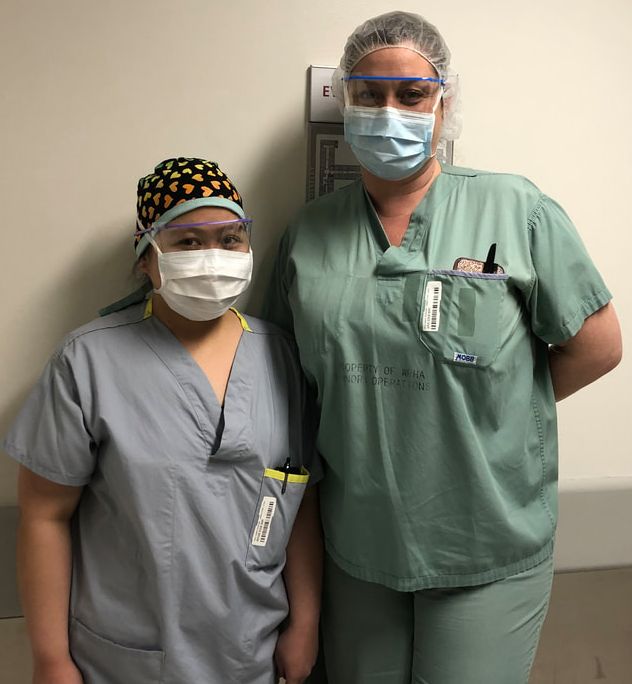
MHC Recreation Manager, Jennifer (right) and recreation student, Kevin (left). MHC’s Long-Term Care program was the fortunate recipient of a Winnipeg Foundation Community Grant earlier this year. Thanks to their instrumental support, the acquisition of additional resources, technology, and training materials has truly made an immeasurable impact on the lives of our residents, patients, and caregivers. Since the onset of COVID-19, new and evolving public health directives have often meant our residents have been faced with less one-on-one time with recreation leaders, heightened visitor restrictions, and fewer opportunities for outings. With the guidelines for acute care evolving constantly as the pandemic progresses, programming must evolve along with it – all without losing the therapeutic benefit to the residents and patients. Additionally, family and visitor restrictions have meant the Long-Term Care team has truly become like an extended family for our residents and patients, making these activities all the more meaningful. With a focus on innovation and a person-centered approach, the Long-Term Care team proposed revised programming to make greater use of personalized items (to reduce sharing) and technology to continue providing meaningful activities. In May of 2021, MHC was fortunate to have the assistance of a Recreation student doing a summer placement to assist with the implementation of the revised programming. This allowed our current recreation team members to focus their full energies on residents and patients. In addition to procuring items and creating innovative Therapeutic Activity Kits, our Recreation student was able to plan a training session and create a resource package for Shared Health support workers on how to use the items with residents and patients. Many thanks to donors like the Winnipeg Foundation for making innovations like this possible! Laura Zelcer, respiratory therapist at MHC for Lungs, helps post-COVID-19 patients with breathing relaxation and control techniques More than 12,000 post-COVID patients in Manitoba have experienced a condition known as long-haul COVID-19. These patients are experiencing breathing difficulty, extreme fatigue, headaches, concentration and cognition symptoms that persist for months after their infectious period has ended. Two rehabilitation programs at MHC—Easy Street and MHC for Lungs—are working together to bring these patients a better quality of life. Laura Zelcer, a respiratory therapist at MHC for Lungs, says the majority of their long-haul COVID-19 patients have “severe shortness of breath, even at rest. “And they’re so young, with no previous medical conditions.” Treatment plans include lung-disease education, breathing relaxation and control techniques, and counselling. The treatment is similar to what other patients in the program experience for help with conditions like chronic bronchitis, emphysema or chronic asthma—except that the post-COVID patients are more fragile. “They can’t be worked as hard or they’ll end up regressing.” Counselling and education for the long-haulers is also different as they are typically younger and were previously healthy. “They’ve had to step back from family roles and work life and learn to pace themselves, to go from being caregivers to letting someone else be the caregiver for them,” said Laura. MHC for Lungs often refers long-haul COVID-19 patients with neurological symptoms to MHC’s Easy Street rehabilitation program. Easy Street offers a safe, simulated community environment—including a bank machine, car, grocery store, sidewalk and street settings—for clients to regain skills after life-impacting health changes like an acquired brain injury or a stroke. Long-haul COVID-19 patients are often experiencing challenges around concentration, short-term memory and brain fog. Easy Street has been working with patients that completed the eight-week MHC for Lungs program, and all the work has been virtual. Easy Street physiotherapist Brad Lucas says he builds on the MHC for Lungs exercises and therapy, reassessing patients and modifying their program as they progress, while occupational therapists use strategies to improve cognition and memory. Programming is customized to help patients achieve specific goals, like returning to work, but Brad says progress can be slow. “Part of their problem is their tolerance for activity. If they overdo it, they need a day or two to recover.” Long-haul COVID patient Frank Adam was diagnosed with COVID-19 in October 2020 and still experiences severe fatigue and issues with breathing, memory and concentration. He uses oxygen most of the day. When he talks he can have trouble finishing sentences. Frank was a professional photographer before COVID-19 hit. He hoped to return to work this August but realizes now that is unlikely. He just finished the MHC for Lungs program and is starting up with Easy Street. Although he’s had some physical strength improvement, severe fatigue is still a big challenge. “It’s going to be a slow process,” says Frank. He’s grateful for the MHC rehabilitation programming, saying it’s “one of the things, besides my family, that’s keeping me positive.” Kris Gladwell, MHCF President & CEO It has been just over one year since I joined the MHC family as President & CEO of the MHC Foundation – and what a year it has been! While I had hoped to meet many of you in person at our 2020 events – such as the Golf Classic, Gala, and Angel Squad – obviously, COVID-19 drastically altered those plans. However, this past year has allowed me to learn about the MHC donor family in an incredibly meaningful way. Thank you. Since the onset of the pandemic, the outpouring of generosity you have shown to Misericordia has been touching and incredibly appreciated. All the messages of support for our health-care heroes have been passed along to them, and your donations have ensured they have continuously remained nourished – physically and emotionally. Your support brings virtual care to MHC by providing new technology and ensuring patients and residents remain connected to their loved ones, preventing social isolation with enhanced programing and services. Your support also helps MHC visitors feel safe as they walk through the halls in the medical-grade masks supplied to them. Please know your generosity at every level is having a tremendous impact on the incredible work taking place at MHC each and every day. On behalf of everyone who has benefited from your support over the last year, thank you. We are beyond grateful. Whatever lies ahead, you can rest assured that MHC’s commitment to providing exceptional and compassionate care will never waver. Thanks to the generosity of donors like you, those on the front lines will continue enhancing patient experiences by incorporating the latest and best practices to re-envision the future of care. As MHC evolves to meet the health-care needs of our community, I am so honoured to lead the Foundation through this exciting time. I invite you to continue to follow Misericordia’s story. We look forward to connecting with you regularly through our MHC Moments e-newsletter, and you can always see what we are up to on social media. Please join us on Facebook, Instagram, LinkedIn, and Twitter! Thank you for being a part of the MHC Foundation family. With gratitude, Kris [Editor's note: Our OR nurses, Yvonne & Colleen (profiled below), were among the more than 30 MHC staff who were redeployed to work in ICUs and acute care at other hospitals during the third wave of COVID-19. Click here to read more about the impact of COVID-19 on MHC.] Yvonne (left) and Colleen (right) During the first wave of the pandemic, members of the operating room (OR) team were reassigned to other program areas at Misericordia, including Colleen Kunderman, registered nurse (RN), who spent two months answering calls on the Health Links – Info Santé COVID-19 line. “During the second wave, I assumed I might be redeployed to another site,” said Colleen over the phone after working the night shift on Cornish 6, a transitional care unit at MHC. “It was nice to stay on-site at MHC – it’s familiar.” Yvonne Mendoza, RN, is an OR team member who in mid-November, like Colleen, was reassigned to transitional care. “At first I was scared. I thought the change would be overwhelming,” said Yvonne candidly. She continued: “But I remembered that I would bloom where I was planted, because I was there for a reason.” Colleen and Yvonne both spent some time over at Misericordia Place, but primarily worked on Cornish 6 (C6) and Cornish 5 (C5) transitional care units, respectively, for the past two months. With their reassignment came big changes both professionally and personally. Both RNs were accustomed to working eight-hour shifts, Monday to Friday, as well as being on call, and had to adjust to working 12-hour shifts, days, evenings as well as sometimes working seven days on. However, the biggest changes came with the new roles themselves. “In the OR, my interactions with patients were limited to usually five minutes or less. On C6, it’s continual patient care, so my duties included: assessment and taking vitals, administering meds, assisting with feeding and transfers, helping patients FaceTime their families, really everything but admin,” said Colleen. Yvonne, who was reassigned to entrance screening during the first wave of the pandemic, expressed that in moving from the OR to C5, the systems and processes are different, incomparable. “At the end of the day, it was very satisfying working on C5. I learned so many new things with the help of the C5 team – they’re amazing and very supportive,” said Yvonne. With visitation restrictions in place in order to protect patients and residents and help halt the spread of COVID-19, health-care providers are important sources of support and meaningful interaction for clients and residents. “We all have had our difficult moments during COVID. But nothing compares to the experience that some patients and residents have had. They’ve lost spouses and couldn’t attend funerals. They haven’t seen family members in person for months on end. Throughout my experience on C6, it made me see that there was a real need and purpose for me – and my colleagues – in being reassigned.” Colleen and Yvonne have now returned to their usual roles in the OR. To both of these health-care heroes and their colleagues, thank you for helping where needed most at MHC. To support MHC health-care heroes like Yvonne and Colleen, please make your gift today! |

have a story to share?We'd love to hear it!
Share your story Categories
All
|


